

PROGRESS AUDIT 003: A Logical Guide to Being Tolerable.
You are not an egg.

This morning, my wife told me that some people don’t bring out the ‘best version’ of me. That is, I admitted, due to a general sense of fear. There are many versions of me (I made a typo there to suggest there were ‘manly’ versions of me to which I quickly course-corrected, because that is one thing I know is not true; ‘manly’ and me do not play well together), all of which are operating with a slow rumble of fear throughout the day. People operate on two options: do something out of fear OR do something out of pride. I believe it is better if everyone operates under the former if you are to operate at all.
At some point, in order to capture the imagination of the emerging generation, somebody somewhere was the first person to utter the words “living your/my best life”, and this is now the reason why everyone is depressed. Because this sounds like a target, something to aspire to or something that is possible. Now it is possible, but not the way that people who attest to it want you to understand.
Here is the ultimatum: You are already living your best life, because that is what your life is. You have already subscribed to the other idiom “You only live once” and have not done the logical alignment to realise that if you only live once, then the life that you have, without any effort in particular, is your best one. And you are, admittedly, disappointed.
I’m sorry to have pointed this out to you.
It’s also your worst life, if that’s any consolation.
That is how lists work.
But when I say to my only parents that they are the best parents I’ve ever had, that is a true statement. There will be some who may try to point out where they could have done better, but I am not that person.
The generation that I belong to (Millennial) is powered by affirmations:
Live your best life
You only live once
Good vibes only
Self-care
Living your truth
That’s how I’m wired
Trust the process
Life is short
All of these are excuses for why this person feels friction in general society.1
I am encouraged to “be myself” and then invited to a fancy dress party, derided for turning up as myself. I could argue that I am being ‘authentic’, but the reality is I’m exposing everyone else as turning “fun” into additional work that shouldn’t be impacting my work-life balance. I get invited to parties less often as a result.
We hear “YOLO” over the hubbub, but when we look, it’s being used as an excuse to have another Krispy Kreme on a Friday. And they’ve taken the best one again.
But you can say almost anything that is merely useless logical calculation, and then take up smoking or buy a dog.
It used to be that we had some strange observation that would justify behaviour; “you can’t make an omelette without breaking eggs” is used to excuse aggressive people who can’t just take a breath. But that isn’t heard as often these days, and is replaced with “trust the process,” “it is what it is,” “all my chickens have hatched, and I’ve got no eggs, so try making an omelette now, you peanut.”
Before I leave that axiom alone, I think it worth highlighting the use of eggs is specifically for omelettes. Other things yes, but omelettes make the list. Without digressing too far into whether a vegan would approve of this as a metaphor for their latest campaign, I’m pretty sure someone on the opposite side of the picket line would have a sign that read “You can’t make an omelette.”2
The very notion of eggs is they will be broken. Either for food or their more productive options: chicks. This does defeat the object of the phrase’s use. By all means, “move fast and break things” if you must, but do not make an excuse that those things were supposed to break and part of the ingredients, rather than the actual result; collateral damage.
How are we supposed to define things as “eggs” in the world outside of a metaphor that is literally a double negative framing of something? If I do the appropriate linguistic algebra, the phrase is literally saying “you make omelettes with eggs.” Now try to justify that to be why you “disrupted” the industry, but not fully being honest that your old business partner is now alone and on the verge of becoming the next Walter White. The ex-CEO of Brewdog probably had this sewn into every t-shirt he wore and had it tattooed across his chest. But in this case, it’s being used to suggest that “success” is made with the ingredient of destroying other people’s lives. An omelette folk metaphor should not be able to carry the weight of silencing dissent.
The millennial adjustment to ‘move fast and break things’ at least didn’t point to objects that undermined the underlying intent. We seem intent on building our lives on proverbs of five words or fewer.
I agree. Life is short, when compared with the infinite passage of time, but it’s taken ages to get here, and if we are speeding towards death, let’s be mindful of others along the way, please.
I cannot abide “Good Vibes Only” as a concept. This doesn’t work. If I got a phone call, as I once did, explaining that the vet had found an untreatable growth in my cat and she would need to be put down, I can’t just scream “GOOD VIBES ONLY!” at him and hang up. It doesn’t work.
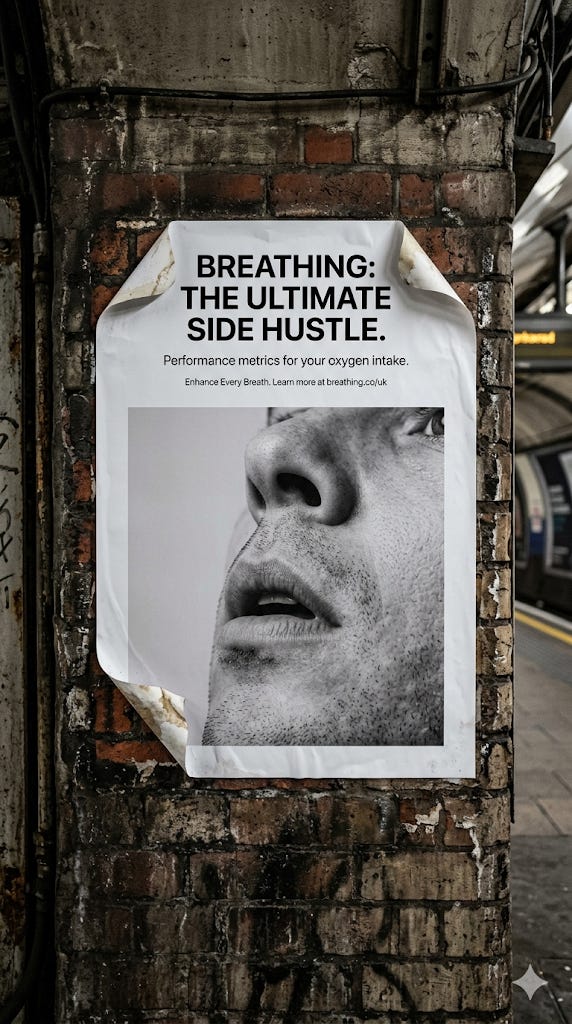
There are people that claim they can maintain said “vibes” with “breath work.” Since when was breathing work? Only in the most stressful of situations, otherwise known as a panic attack. If we have a generation that are experts at breath work, we must be in an international health crisis. Every member of Gen Z are hiding their constant state of panic behind an oversized hoodie slogan.
And so we have got a population of people living through their screens, showcasing their life with captions to affirm their life choices, without just actually inhabiting them. Only made worse is we have too quickly passed this onto future generations, who have had to find ways to live ‘authentically’ and make sure that that is also captured on social media so people can approve of it.
Just approve, please. Approve of my schedule. Approve of my job. Do not be silent.
There’s a world of concern that people are only sharing their curated life online. But there is silence when it comes to just getting people to live.
What this doesn’t mean is find ways of captioning your life through a t-shirt that says “GAME ON” or “I WILL GO PLACES” or “ADVENTURE! Assembly required.” Be careful of these.
I have a hoodie that reads, “The Wilderness Awaits”, which sounds edgy and cool, but is probably the most terrifying thing to consider. You believe it’s going to be a scenic hike in the New Forest, but suddenly there’s no 5G coverage, and Waitrose is replaced by a SPA. No Gastro Pub in sight. I like the wilderness as long as there’s a proper facility to ensure I can have a suitable bio break and eat tasty things in the midst of experiencing said wilderness. I do not want the wilderness subjected to me. The idea of adventure might be fun from the outside, which is easy to imagine when binge-watching Netflix mini-series. But imagine that actually happening to you.

They say be careful what you wish for, but in this case, you have either brought incredible disaster on yourself with zero prep, or, as hacked to death in the preceding paragraphs, stated things over yourself that contain no actual meaning and your single solitary life is winning and losing at every ranking you can place on it.
Stop it.
Here are some alternatives that you can utilise to make yourself more tolerable to the incoming generations:
One life is already too much responsibility
I have settled for a good life, my apologies
Be your many selves. Embrace your inconsistency.
Check you’re still breathing. This is enough.
Do not disturb
Be authentically difficult
Life may be short, but please do explain in more detail your life-changing sourdough starter
Remove all vibes from your activities. Strive instead for a life that is logically sound.
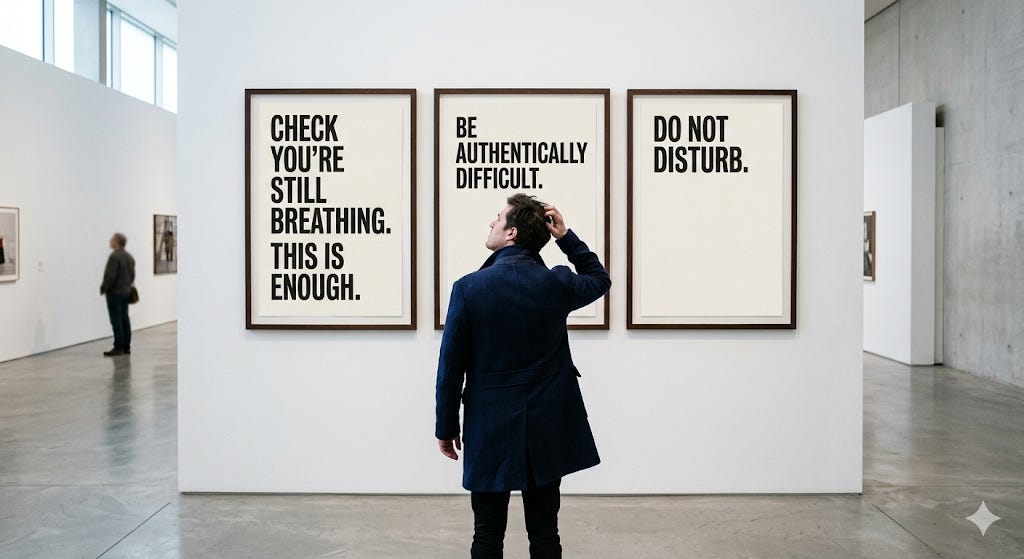
This person is me.
It is notable that this phrase traces back to the French Revolution—a period where “collateral damage” was considered a standard operating expense for social progress. That the French chose the omelette as their primary metaphor for world-altering change is entirely predictable; one can hardly imagine the Jacobins rallying the masses with a metaphor involving toast or cornflakes.
The rhetoric would have surely stumbled elsewhere; “you can’t have breakfast without pouring the milk” lacks the requisite gravitas to stir a mob. The fundamental flaw in their logic, however, is that while the omelette is hailed as a “grand result,” it consists entirely of the “precious things” that were destroyed to make it. We might exercise more caution before suggesting that the best way to improve a society is to break the individuals within it.